'Old World Order Not Coming Back': Canadian PM Mark Carney's Shot at US in Davos
Mark Carney warns at Davos 2026 that the old world order is over, urging middle powers to adapt amid US-EU tensions.
advertisement
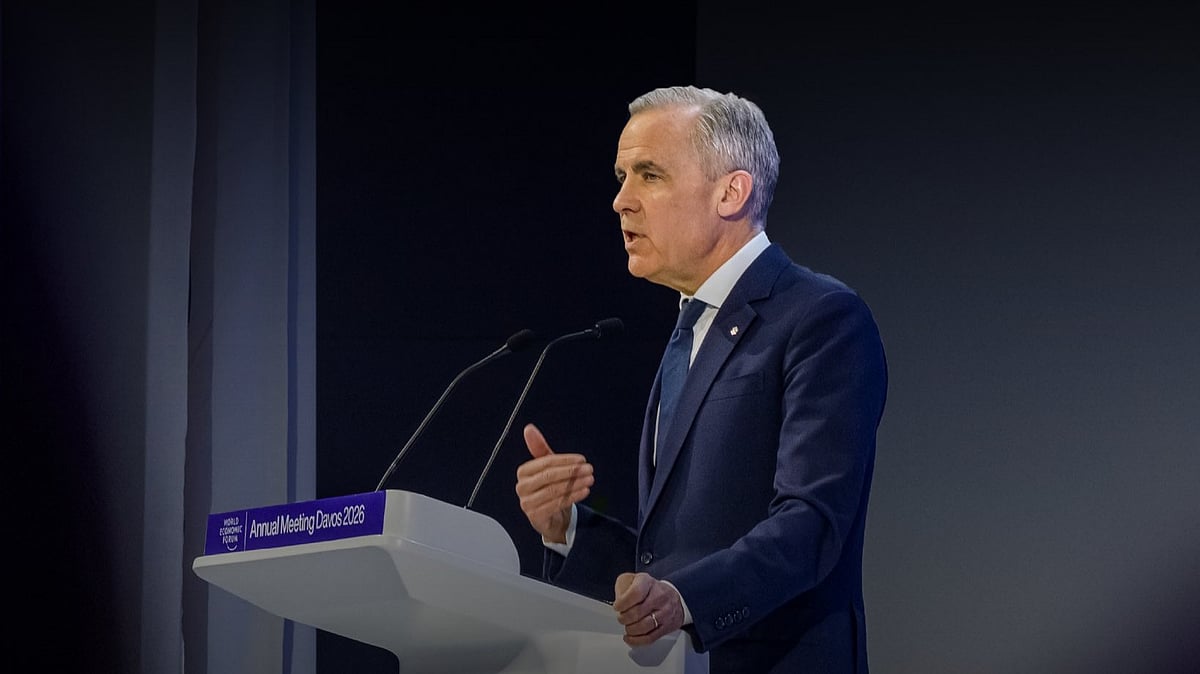
Mark Carney, Prime Minister of Canada, addressed the World Economic Forum 2026 in Davos, Switzerland, warning that the US-led global system of governance is experiencing a significant rupture. Carney stated that the previous rules-based international order is fading, and the world is now facing intensified great power rivalry. His remarks came as US President Donald Trump prepared to address the summit, with tensions high over the US push to acquire Greenland and the resulting strain on transatlantic alliances.
According to The Guardian, Carney emphasised that the current situation is not a transition but a rupture, highlighting that middle powers like Canada must adapt to a new reality where compliance with major powers no longer guarantees safety. He noted that the old order, which provided open sea lanes, a stable financial system, and collective security, is being replaced by a system where powerful nations use economic integration as coercion.
As reported by The Hindu, Carney reiterated Canada’s opposition to US tariffs linked to the Greenland dispute, calling for focused talks to achieve shared objectives of security and prosperity in the Arctic. European leaders, including French President Emmanuel Macron, also responded to the US stance, vowing to stand against aggressive policies and warning against new forms of imperialism or colonialism.
Coverage revealed that the World Economic Forum 2026 brought together leaders such as Donald Trump, Mark Carney, and Ursula von der Leyen, with the summit’s theme focusing on dialogue amid global uncertainty. Notably, Indian Prime Minister Narendra Modi and Chinese President Xi Jinping did not attend, while delegations from their countries participated in discussions on economic and security issues.
In his speech, Carney warned, “The question for middle powers, like Canada, is not whether to adapt to this new reality. We must. The question is whether we adapt by simply building higher walls – or whether we can do something more ambitious.”
Analysis showed that the atmosphere in Davos was tense, with visible signs of protest such as the “No Kings” message displayed on the mountainside ahead of Trump’s address. The sign, interpreted as a critique of concentrated power, reflected broader concerns about the direction of global leadership and the erosion of multilateral norms.
Further details emerged regarding the summit’s schedule, with Trump’s speech set for 21 January 2026, drawing significant attention from both political and business leaders. The summit’s agenda included high-level meetings on security, trade, and the future of the Arctic, with the US-EU dispute over Greenland overshadowing other discussions.
“Middle powers must act together, because if we’re not at the table, we’re on the menu,” Carney stated, underscoring the need for collective action among nations that lack the leverage of great powers.
At the end of the day, as details emerged, other global actors such as China called for increased cooperation and dialogue, warning that trade and tariff wars have no winners. The World Economic Forum 2026 thus became a focal point for debates on the future of global governance, economic integration, and the shifting balance of power.
Note: This article is produced using AI-assisted tools and is based on publicly available information. It has been reviewed by The Quint's editorial team before publishing.