Israeli Strikes In Lebanon Kill 16 As US-Iran Talks in Switzerland Get Postponed
Israeli airstrikes in southern Lebanon kill at least 16 as US-Iran talks stall amid ongoing regional tensions.
advertisement
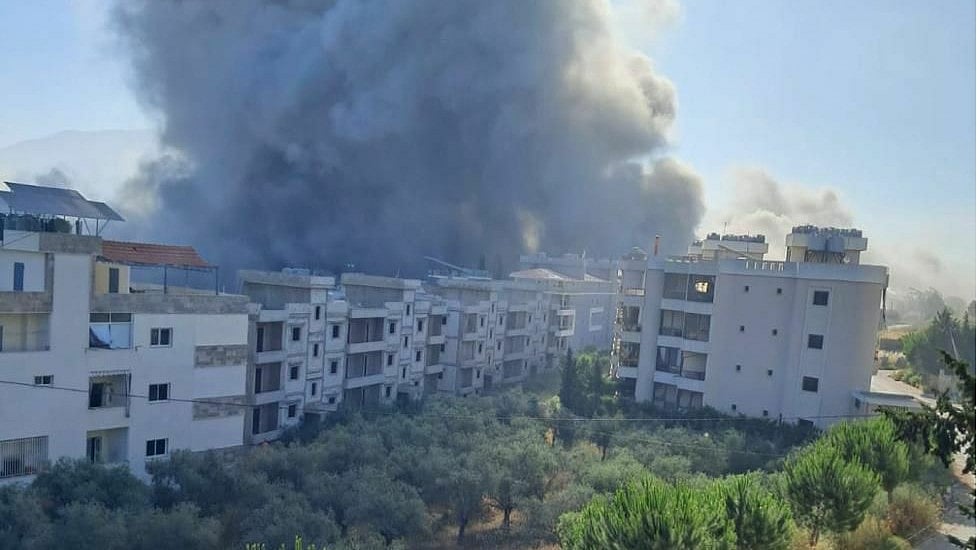
At least 16 people were killed in Israeli airstrikes across southern Lebanon overnight, as fighting between Israeli forces and Hezbollah intensified. The escalation coincided with the abrupt postponement of planned US-Iran talks in Switzerland, which were intended to solidify a peace agreement and address ongoing hostilities in the region. Israeli military operations in southern Lebanon continue, with the stated aim of countering Hezbollah activity near the border.
Israeli forces struck multiple targets throughout southern Lebanon, resulting in at least 16 fatalities as reported by Lebanon’s state-run National News Agency. The attacks occurred as Hezbollah reported intense fighting in the area, and the Israeli military maintained its position that continued operations were necessary to counter threats from the Iranian-backed group.
As highlighted by Deccan Herald, the Israeli military confirmed that four of its soldiers were killed in southern Lebanon, marking the first such losses since the recent US-Iran deal was signed. Switzerland announced the postponement of follow-up talks, which were scheduled to address broader regional security and nuclear issues. The delay was attributed to the deteriorating security situation on the ground.
As reported by Hindustan Times, the White House stated that Vice President JD Vance postponed his trip to Switzerland due to logistical challenges, while Iran’s Supreme Leader Ayatollah Mojtaba Khamenei publicly endorsed direct negotiations with the United States. The US military also lifted its blockade on Iranian shipping, allowing oil tankers to resume passage through the Strait of Hormuz, though US Navy vessels remain in the region to monitor compliance with the agreement.
"Donald J Trump is the only head of state in the entire world who is sympathetic to the nation of Israel at this moment in time," JD Vance said during a news briefing, as cited in multiple sources.
Reporting indicated that the cancellation of the US-Iran talks was directly linked to the renewed violence between Israel and Hezbollah. The talks were intended to implement a memorandum of understanding that included a 60-day window for negotiating a permanent agreement on Iran’s nuclear programme and regional security arrangements. Both sides had gathered in Switzerland, but the escalation in Lebanon led to an abrupt halt in diplomatic efforts.
Hezbollah claimed responsibility for targeting Israeli forces near Nabatieh, a city in southern Lebanon that has experienced significant destruction and displacement due to the conflict. Israeli airstrikes in response killed at least 18 people and wounded 33, according to Lebanon’s health ministry, coverage revealed. The city’s annual Ashura ceremony, typically attended by thousands, was marked by mourning and reduced attendance amid ongoing insecurity.
Israeli Prime Minister Benjamin Netanyahu has stated that Israeli forces will remain in southern Lebanon “for as long as necessary,” despite calls for withdrawal and the terms of the US-Iran agreement, as details emerged. The agreement calls for an immediate halt to military operations on all fronts, including Lebanon, and for the territorial integrity and sovereignty of Lebanon to be respected.
"We expected things to be better than they are now. We wanted a real ceasefire," said Mehdi Sadek, head of the Nabatieh ambulance service, reflecting local sentiment amid continued violence.
US Vice President JD Vance and President Donald Trump have both publicly urged Israel to respect the peace process and cease hostilities, but Israeli officials have expressed concerns that the agreement does not adequately address threats from Hezbollah or Iran’s missile programme. The ongoing violence has raised doubts about the durability of the ceasefire and the prospects for a lasting resolution, analysis showed.
Despite the ceasefire announcement, intermittent clashes and airstrikes have continued in the so-called “security zone” occupied by Israeli forces in southern Lebanon. Many residents remain displaced, and civil defence crews are working to recover bodies and clear rubble in affected areas, following reports from local officials. The humanitarian situation remains critical, with uncertainty over whether the ceasefire will hold.
"Here in Nabatieh, it still is the same; it’s even harder. It’s unclear whether there’s a ceasefire or not," said Hussein Fakih, regional head of the Nabatieh civil defence.
International observers continue to monitor the situation as diplomatic efforts remain stalled and both sides exchange accusations of ceasefire violations. The broader regional context, including the reopening of the Strait of Hormuz and ongoing negotiations over Iran’s nuclear programme, adds further complexity to the evolving crisis, as coverage revealed.
Note: This article is produced using AI-assisted tools and is based on publicly available information. It has been reviewed by The Quint's editorial team before publishing.