'Innocent Until Proven Guilty But...': Ex CJI Chandrachud on Umar Khalid's Bail
'Bail before conviction should be a matter of right," said ex CJI D Y Chandrachud on bail rights of Umar Khalid.
advertisement
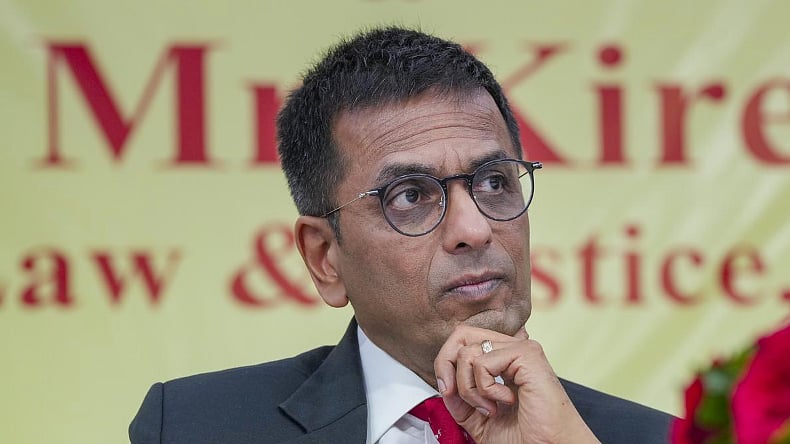
Former Chief Justice of India DY Chandrachud has stated that bail before conviction should generally be a matter of right, but emphasised that courts must conduct a thorough examination in cases involving national security. His remarks follow the Supreme Court’s recent denial of bail to Umar Khalid and Sharjeel Imam, who have been incarcerated since 2020 in connection with the Delhi riots conspiracy case.
According to The Indian Express, DY Chandrachud explained that the law presumes every accused person is innocent until proven guilty, and that pretrial detention should not serve as punishment. He highlighted the irreversible loss suffered by undertrial prisoners who are acquitted after years in custody, questioning how such lost time could be compensated.
As reported by Hindustan Times, Chandrachud clarified that bail can be denied if there is a risk of the accused repeating the offence, tampering with evidence, or fleeing.
As highlighted by Deccan Herald, Chandrachud also expressed concern over the delays in the Indian criminal justice system, noting that if a speedy trial is not possible, the accused is entitled to bail. He described the denial of bail by lower courts as a significant issue, attributing it to judicial apprehensions about their integrity being questioned, which results in a high volume of bail cases reaching the Supreme Court.
During a session at the Jaipur Literature Festival, Chandrachud emphasised that no area of the Constitution should be immune from judicial review, including cases where national security is cited. He argued that the presumption of innocence must remain central, and that even in national security cases, courts are duty-bound to carefully scrutinise whether such concerns are genuinely involved.
Panel discussions at the Jaipur Literature Festival further debated the issue of prolonged incarceration under anti-terror laws, with legal experts highlighting that neither Umar Khalid nor Sharjeel Imam was accused of direct violence. The panel described five years of pre-trial detention as unjust and inconsistent with constitutional values.
Legal analysis underscored that the right to a speedy trial is fundamental, and that delays in the justice system undermine both liberty and dignity. The discussion also referenced the Supreme Court’s role in granting bail and the need for transparency in judicial appointments to strengthen public trust.
Further commentary noted that the Supreme Court, in denying bail to Khalid and Imam, distinguished between “ideological drivers” and those accused of executing orders, holding that the former cannot claim parity with ground-level facilitators. The court’s decision was based on the Unlawful Activities (Prevention) Act, which criminalises actions threatening national security or public order.
Judicial perspectives emphasised that the volume of bail cases before the Supreme Court is unprecedented, and that systemic reforms are needed to address delays and ensure that pretrial detention does not become punitive.
“If there is no reasonable prospect of a trial ending within a reasonable time, the fundamental right to a speedy trial and the right to life must take precedence,” Chandrachud asserted.
Note: This article is produced using AI-assisted tools and is based on publicly available information. It has been reviewed by The Quint's editorial team before publishing.