
Rebranding Rahul: Decoding Gandhi’s Talk at LSE
Akhil Oka attended Congress President Rahul Gandhi’s talk at London School of Economics – and here’s his analysis.
advertisement
“Thank you for this unscripted Mann Ki Baat!”, a delighted person in the audience shouted with a great amount of fervour. This final intervention may well have been the cry of an ardent supporter, but there was nothing principally wrong in whatever he expressed.
Rahul Gandhi, the Congress president and a possible contender for the coveted office of the Prime Minister of India in the future has been on a spree of visits to foreign destinations where he has been interacting with different sections of the society.
His visit to the London School of Economics and Political Science (LSE) has generated a considerable amount of buzz. For, despite being in politics since 2004, there is very little that Indians know about Rahul Gandhi, compared to many other politicians. As he was neither a minister in the successive United Progressive Alliance (UPA) governments nor was he put forth as a face of the party in the 2014 General Elections, public perception of Rahul has been quite discouraging to say the least.
It is this mystery and intrigue about Rahul’s persona which the Congress has been trying to use to its advantage in the last few months.
‘India’s Strength Lies In Non-Violent Ideas’
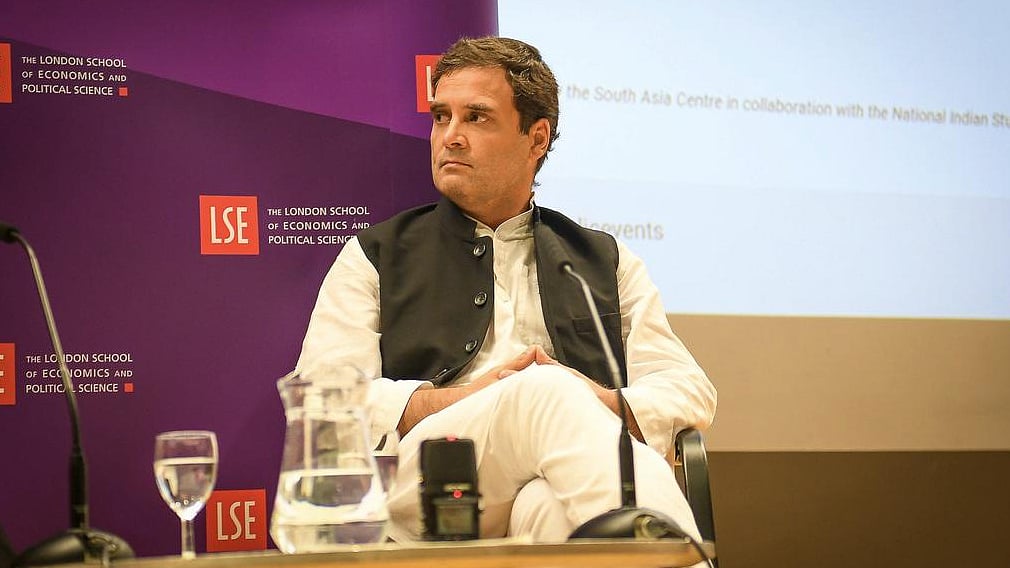
Organised by LSE South Asia Centre and the National Indian Students and Alumni Union (NISAU), ‘In Conversation with Rahul Gandhi’ was touted as the inaugural event of the India Townhall series.
Moreover, he urged people to look at things from the perspective of others as it can be very valuable. According to him, India’s strength lies in non-violent ideas and thus, the country has a huge role to play in the global context.
At this juncture, Dr Mukulika Banerjee, the Director of LSE South Asia Centre commenced her role as the interviewer.
There were ten questions in total focusing on a range of issues including what he brings to the table apart from his family name, views on secularism, social justice and economic situation, implementation of Swaminathan report, SWOT analysis of the party, 1984 and so forth.
‘15 Years In Politics Is Serious Experience’
On his contribution, he stated that he had seen violence in life and thus, knew the importance of reaching out and listening to people. Acknowledging that he had borne the brunt of massive attacks, he maintained that 15 years in politics is serious experience. He strongly asserted that he loves India and stands for the weaker sections of the society.
Regarding economics, Rahul primarily concentrated only on agriculture. Emphasising that even the average farmer can take on agriculture policy experts, he lambasted the government for its inability to produce jobs and instead, harping on divisive issues.
Advocating focus on small and medium scale, low cost housing, infrastructure as the solution, he implored upon the government to acknowledge the problem in the first place. Government should act as an enabler, as per his hypothesis. With reference to the implementation of the Swaminathan Report, he admonished the Government for the lack of intent in improving lives of farmers and promised to deliver on this front. While he hit the right notes on all these points, there were some inherent contradictions.
Some Realities That Cannot Be Washed Away
For instance, a Congress spokesperson’s categorical assertion during the recent Gujarat Assembly elections campaign about Rahul’s higher caste status, lack of representation of women in important committees of his party and the failure of UPA to effectively act on the recommendations of the Swaminathan Report are realities that cannot be washed away.
It was interesting that he did not respond initially to the question on his views about secularism and it had to be reiterated again. The answer was a bit ambiguous as well, only stating that no person should be rendered voiceless.
He reiterated that he was fighting against the attack on Indian institutions and on the inclusive idea of India – reflected through incidents like the press conference of the Supreme Court judges and sacking of journalists. Responding to a query on the SWOT analysis of the Congress party, he made some key observations.
As the Congress had closed itself over a period, it has the opportunity of bringing in millions of Indians and delivering a robust organisation.
Also, he had no hesitation in admitting that arrogance was the biggest threat to the party. Confessing that the internal fights between the old and the new guard cost them in the 2014 general elections, he reiterated the need to involve more young people in the organisation.
Controversy Surrounding 1984 Riots
Now, it was the time for the infamous 1984 question. Earlier in the day, he had stoked a controversy by denying the role of his party in the anti-Sikh riots. However, he had a slightly different take in this event.
Thereafter, he maintained that there was no question of Congress being a party to any communal incident under his tenure as Congress president. Thus, he once again invoked his personal tragedy and cleverly sidestepped the justice denied to the victims for so many decades. The last question posed to him was about the criteria for the Prime Minister’s job in the opposition coalition.
As per Rahul, the priority of the opposition was to defeat the BJP and other deliberations would commence only post elections. Also, he added that Congress would form an alliance only with those parties that are ideologically opposed to the BJP. Hence, this implies that the Congress is open for a wider discussion on the PM’s name and ready to compromise.
These comments can also be a rebuff to a party like Shiv Sena, that currently opposes BJP but is very close to their ideological position on many issues.
From GST to Women’s Reservation Bill
Subsequently, the floor was opened for questions from the audience. First, he was asked about his excessive focus on agriculture to which he replied that it is linked to other sectors of the economy and, thus, nothing can be viewed in isolation.
Regarding parliament, he openly spoke about how rudderless the House had become, with law making powers concentrated only in the hands of the PM, and promised to empower the MPs. While most of the audience appreciated this in unison, Rahul not only did not elaborate on the proposed changes but was conveniently silent on his own poor record in Parliament also – ranging from his attendance to lack of participation in the legislation process.
Lastly, a student questioned about the possibility of a female PM to which he responded that while he was not a clairvoyant, he assured that more women leaders would be inducted at every level of the organisation.
‘One Had the Liberty to Ask Any Question’
The session came to an end due to paucity of time. It is a pity that many questions remained unanswered.
For instance, I had a very pertinent question about the decision of the Punjab government (ruled by the Congress) to amend the provisions of the Indian Penal Code, paving way for a stringent Blasphemy law, that has no place in modern India.
His answer would have effectively reflected whether he and his party really stand for the principles that he espoused in his talk. Most of the questions allowed him a certain degree of leeway to talk in general terms rather than specifics. However, there are key aspects that were clearly visible. While elementary vetting of attendee names must have taken place, there were no complaints from anyone of being denied an entry ticket.
In terms of the political ramifications, this seems to be one of the many such endeavours in the run up to the next General Elections.
Every effort is being made to project Rahul as the victim who has endured personal attacks with a smile, someone who makes mistakes but is willing to learn, a person who expresses himself on most issues of critical importance and is firmly against hate politics.
This is in stark contrast to the attitude of the Modi government which often relies on aggression as the best form of defence and is perceived to be ignorant to some of the grievances of the people.
On their part, the Congress has a tough challenge in tackling the personal charisma of Modi, which is still intact. Thus, whether the re-branded image of Rahul can convince the voters, it will be fascinating to watch out for in the upcoming elections.
(Disclaimer: The claims, statements and views expressed in this article are solely of the citizen(s) who have written to us. The Quint does not endorse these claims, statements and views, and is not responsible for the same. ‘My Report’ is The Quint’s platform of Citizen Journalism. Share your queries or grievances with us at myreport@thequint.com)
- Access to all paywalled content on site
- Ad-free experience across The Quint
- Early previews of our Special Projects
Published: 26 Aug 2018,03:44 PM IST