Panipat’s Textile Recyclers Do the World’s Dirty Work—And Get None of the Credit
Rich nations have outsourced not just the labour, but the environmental cost to Panipat.
advertisement
This article has been authored by a member of The Quint. Our membership programme allows those who are not full-time journalists or our regular contributors to get published on The Quint under our exclusive 'Member's Opinion' section, along with many other benefits. Our membership is open and available to any reader of The Quint. Become a member today and send us your articles on TQmembersonly@thequint.com.
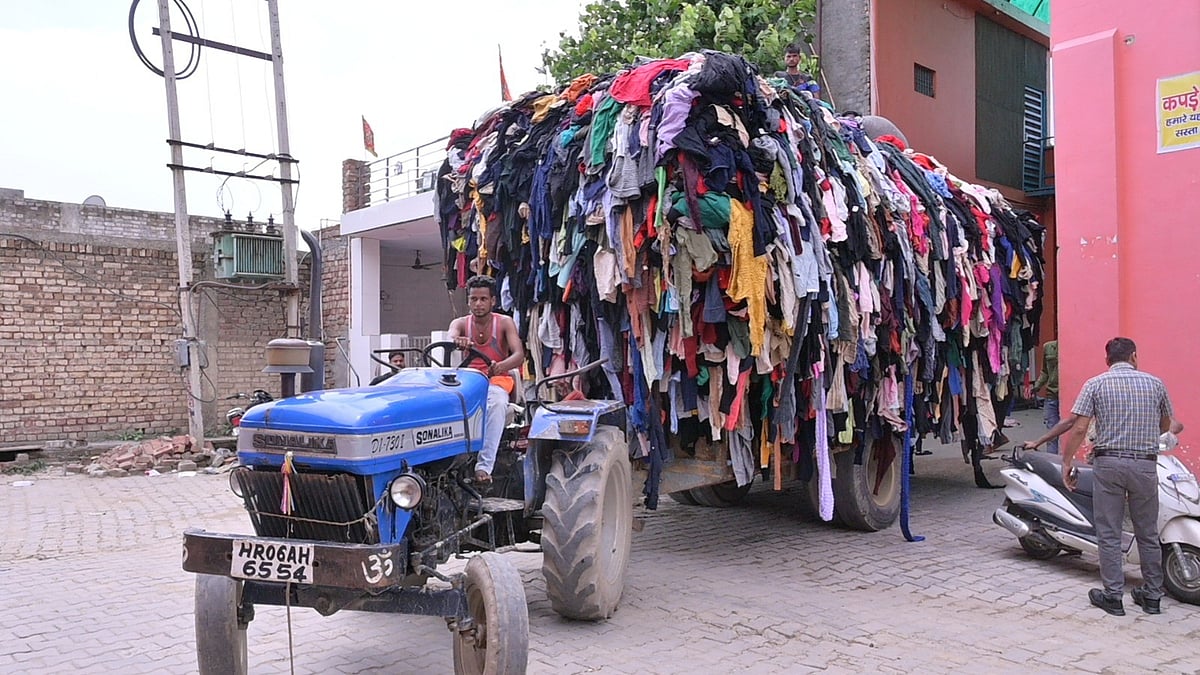
Panipat, a city of roughly 500,000 people in the state of Haryana, carries a quiet, extraordinary distinction: it recycles more discarded clothing than almost anywhere else on earth.
Known as the "cast-off capital of the world," it processes millions of tonnes of used garments sent from Europe, North America, and East Asia every year, transforming worn-out jeans and last season's coats into blankets, industrial rags, insulation material, and new yarn.
The city keeps tonnes of textile waste out of landfills—landfills that belong to the countries which created the waste in the first place.
A recent CNN report told this exact story, but mostly through a narrow lens of the difficult working conditions of the labourers who sort and shred these clothes.
Those concerns are real and should not be dismissed. But reducing Panipat's textile recycling industry to a tale of suffering—with no context, no acknowledgement of what it achieves, and no examination of who is ultimately responsible—is journalism that misleads more than it informs.
Over 4 million jobs generated by India's textile recycling sector
100 billion garments are produced globally every year, and most are discarded quickly
<1 percent of brand take-back clothes are actually recycled into new garments
When the Burden Falls Elsewhere
India is a developing country. That context matters enormously. Panipat's textile recycling industry does not exist in spite of poverty—it exists because global economics dictated that the cheapest place to process the wealthy world's discarded clothing is a country where labour costs are low. The rich countries of Europe and North America send their cast-offs to Panipat because it is far cheaper than recycling at home.
They have outsourced not just the labour but the environmental cost, the health risk, and the moral complexity—and then sent reporters to document how grim it looks on the other end.
(Photo Courtesy: Priyanka Rai)
Meanwhile, the industry that has grown around this reality employs over four million people across India. For millions of families, it provides livelihoods, income, and a place in the economic structure of a country that is still building its infrastructure and social safety nets. To portray this as pure exploitation, without acknowledging that the alternative for many workers may be no income at all—is to ignore the lived reality of economic development.
The Plague Fashion Pretends Isn’t There
The root cause of Panipat's burden is not India's poverty. It is the insatiable consumption of clothing in wealthy nations—what can only be called an illness of excess.
The UN Environment Programme has tracked a 60 percent increase in clothing purchases over two decades, with garments worn for half as long as before. A staggering 100 billion garments are produced each year. Fashion production has surged 50 percent since 2000. Synthetic fibres, comprising 60 percent of global apparel purchases take up to 800 years to decompose.
The US generates 17 million tonnes of fashion waste annually. European nations are not far behind. These countries have the wealth, the infrastructure, and the regulatory capacity to build domestic recycling systems, and have largely chosen not to, because sending the problem abroad is cheaper.
Three Honest Solutions
1. Pay fairly—brands must buy recycled at premium rates: If global fashion brands are committed to sustainability beyond marketing copy, they must purchase recycled textile products at prices that reflect the true cost of responsible production. When Panipat's recycling units are paid a premium, they can invest in better machinery, safer working conditions, improved ventilation, and health protections for their workers.
2. Rich countries must recycle their own clothes at home: If the working conditions in Panipat are truly unacceptable by the standards of the countries generating the waste, then those countries have a straightforward obligation: build the infrastructure to handle it themselves.
Europe is beginning to develop Extended Producer Responsibility frameworks for textiles—a step in the right direction. But regulation without enforcement and investment in domestic recycling capacity simply shifts the burden further. If you will not accept these conditions in your own country, you should not be exporting them to ours.
(Photo Courtesy: Priyanka Rai)
3. Address the addiction—reduce fast fashion consumption: This is the most important and the most ignored solution. No amount of recycling, however efficient, however well-resourced, can keep pace with 100 billion new garments per year. Panipat is a pressure valve on a system producing far more than the planet can absorb. Governments in wealthy nations must implement serious demand-reduction policies: taxation on fast fashion, mandatory minimum garment lifespans, restrictions on ultra-cheap synthetic imports, and public education campaigns that treat overconsumption for what it is, an environmental and ethical crisis.
Credit Where it is Long Overdue
India has historically maintained a far more sustainable relationship with clothing than the countries now criticising its recycling industry. Practices of handing down garments across generations, repurposing old cloth into quilts and cleaning rags, and mending rather than discarding are woven into Indian domestic culture. It is the flood of global fast fashion trends and the economic logic of a world that has decided India should clean up after everyone else, that puts this culture under pressure.
Panipat's workers deserve better conditions. That is unambiguous. But they also deserve recognition: they are performing an essential global service, at personal cost, for an industry headquartered in cities far more comfortable than theirs.
That is where the story begins. Panipat is only where it ends up.
(Priyanka Rai is a communication strategist and freelance journalist working at the intersection of policy, development, and MSME ecosystems. This is an opinion piece, and the views expressed above are the author’s own. The Quint neither endorses nor is responsible for the same.)