Bhagat Singh, Urdu and Revolution: Understanding His Multilingual World
Exploring Bhagat Singh’s Urdu connection and the language, literature and ideas that shaped his revolutionary world.
advertisement
Bhagat Singh is remembered as one of the most prominent figures of India’s revolutionary movement, often associated with his writings on revolution, freedom, socialism and colonialism. Yet, beyond his political activities and widely discussed ideas lies another important aspect of his intellectual life: his engagement with language and literature.
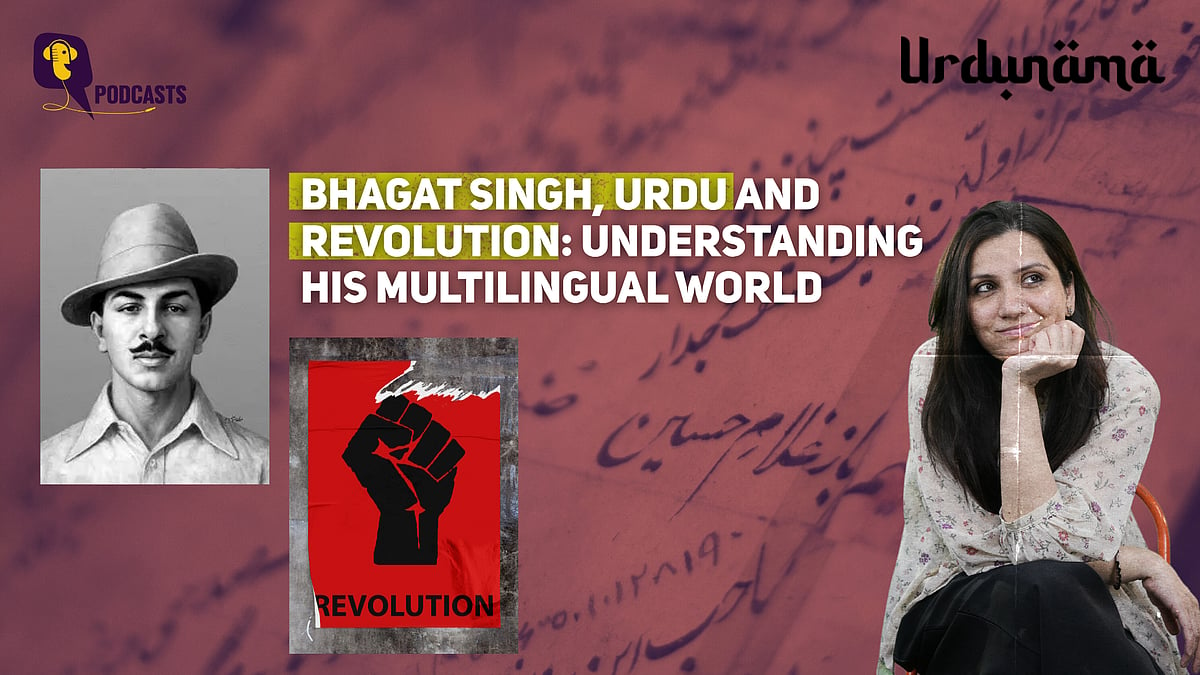
Ahead of Bhagat Singh’s 119th birth anniversary, Urdunama explores this lesser-known dimension through a conversation between Fabeha Syed and Professor Chaman Lal, former Professor and Chairperson of the Centre of Indian Languages at Jawaharlal Nehru University and honorary advisor to the Bhagat Singh Archives & Resource Centre.
Professor Lal, who has spent decades researching Bhagat Singh’s writings, reading and intellectual legacy, offers insights into the multilingual environment in which the revolutionary grew up and developed his political thought.
Although Bhagat Singh did not write extensively in Urdu, the language was not unfamiliar to him. Urdu formed part of his early education and was embedded in the literary, cultural and political environment of the Punjab of his time. For Bhagat Singh and his contemporaries, languages did not necessarily exist in rigid compartments. Literature, newspapers, political writing and poetry often moved across linguistic boundaries.
The conversation also invites us to reconsider the way Bhagat Singh is remembered today. His image is often reduced to that of a revolutionary martyr, but his writings and reading habits reveal a more complex intellectual personality—one shaped by a diverse literary and linguistic milieu.
By examining the place of Urdu in Bhagat Singh’s world, Urdunama brings attention to the connections between language, literature and political thought. It is a reminder that revolutionary ideas do not emerge in isolation; they are also shaped by the books people read, the languages they encounter and the cultural worlds they inhabit.
This episode offers an opportunity to look at Bhagat Singh not only as a revolutionary, but also as a reader, writer and thinker shaped by a multilingual India.