Low Funds, Pending Dues, No Work: How Govt Crippled MGNREGA Before Renaming It
A mere 1.4 percent of the households that availed employment under MGREGA completed 100 days of work, data shows.
advertisement
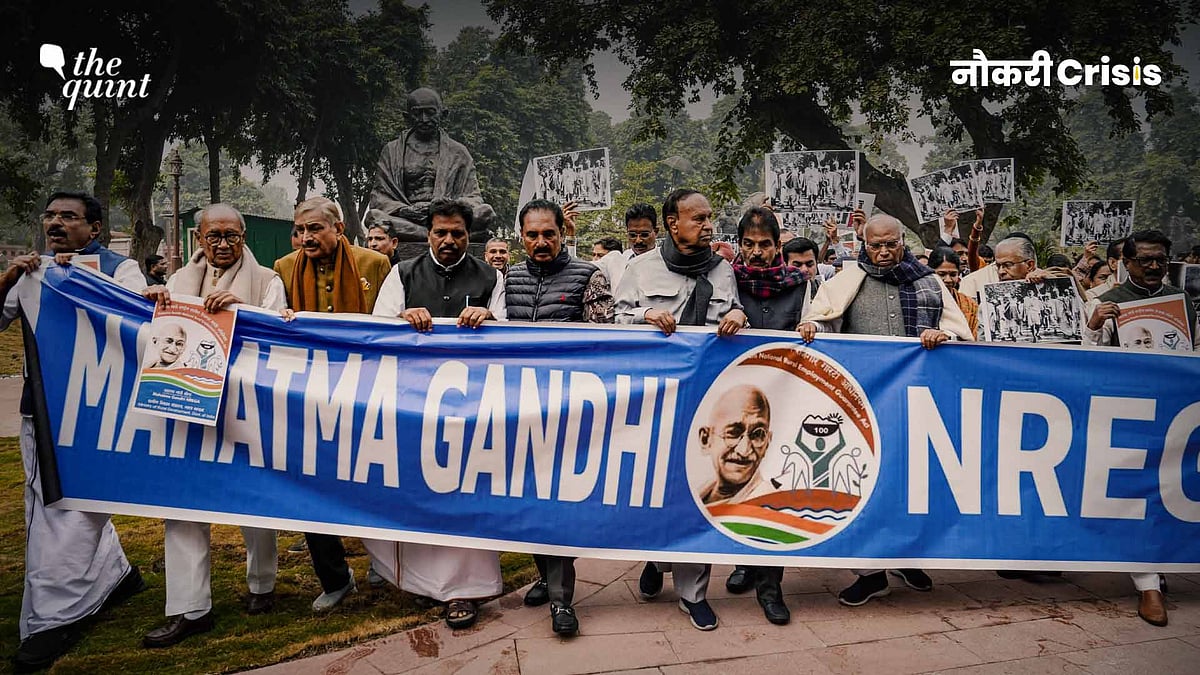
Two days after the Narendra Modi-led government introduced the Viksit Bharat- Guarantee for Rozgar and Ajeevika Mission (Gramin) or the G RAM G Bill, 2025, it was passed in the Lok Sabha on Thursday, 18 December as the Opposition staged a walkout. The G RAM G Bill proposes to replace the Mahatma Gandhi National Rural Employment Guarantee Act (MGNREGA), which provides a livelihood source to millions of rural Indians.
The proposal drew sharp criticism from the Congress, whose UPA government had enacted the Bill two decades ago under the leadership of then prime minister Dr Manmohan Singh. MGNREGA was enacted to provide a legal guarantee of salaried employment to rural households so that they can be active participants in creating rural infrastructure instead of passive dole recipients.
Moments after it was passed, Congress MP Priyanka Gandhi told media persons that the G RAM G Bill will be the "death of MGNREGA." Earlier, she questioned the intention behind removing Mahatma Gandhi’s name, while the party’s general secretary KC Venugopal labelled it a “cosmetic exercise to paper over the deliberate neglect being meted out to this scheme.” Venugopal pointed out that MGNREGA workers have been demanding higher wages even as arrears remain unpaid.
In this story, The Quint examines the gaps in the implementation of MGNREGA to see if a rebranding exercise can solve the problem of high rural unemployment in the country.
Insufficient Budget Allocation for MGNREGA
The mandate of MGNREGA is to provide at least 100 days of unskilled manual work in a year as guaranteed employment to every household in rural areas as per demand. This employment should result in the creation of productive assets of prescribed quality and durability. Other than strengthening the livelihood resources of the poor, the core objective of the Act is to ensure social inclusion.
As per the Act, the Central government bears the cost of wages, material and administrative expenses, with a small contribution from some states. Every year, the allocation to MGNREGA is declared in the Union Budget, and the Centre releases funds to states based on demand projections. If the demand for work is higher than the Budget allocation, the Centre may release additional funds during the year.
Data from the Ministry of Rural Development shows that the Centre has had to revise the budget estimates mid-year to cope with the high demand of work. In other words, the allocation of funds to the scheme has been lower than the actual requirement.
The spike in demand in the years 2020-21 and 2021-22 may be attributed to the reverse migration during the Covid-19 pandemic—when migrant workers returned en masse to their native villages and depended on livelihood opportunities there till the nation-wide lockdown lifted.
Modi Govt Proposes 125 Workdays; Provides Only 50
However, despite the high demand and funds released in those years, the average number of days for which employment was provided hovered around 50 days, or half the mandate.
The new bill proposes to increase the number of guaranteed employment days to 125—a welcome step that would mean nothing when the Modi government has consistently been falling short on the 100-workdays mandate.
According to a Parliament response, there were 8.6 crore active (who have worked in the last three financial years) jobseekers under MGNREGA as of 4 December. The same response shows that the programme generated 163.29 crore person days in 2025-26.
Persondays are calculated by multiplying the total number of workers with the number of days each person worked. Now, data from a Parliament Response shows that the number of workers provided employment under MGNREGA have decreased over the years:
Does this mean that fewer workers are working for a greater number of days? Unfortunately, no (since the average number of days each person worked remains around 50 days).
Data shows that the number of persondays has also fallen over the last six years.
Fewer workers, fewer workdays per worker, and fewer persondays generated, all point to one thing— the overall employment generated under the scheme has declined.
1.4% Households Under MGREGA Completed 100 Days of Work
More than 27 crore rural workers (in over 16 crore households) were registered under MGNREGA as on 16 December, i.e. nearly 18.5 percent of India’s population.
The data also states that 6.97 lakh families—or 1.4 percent of the households that availed employment under MGREGA—completed 100 days of work.
Another interesting data point is the ratio of persondays generated using central vs state funds. The latest progress report shows that 99.5 percent of the persondays are created using funds from the Centre.
The Modi government has now proposed that this ratio be modified to a 60:40 arrangement, where the Centre bears 60 percent of the total cost and respective state governments are responsible for the remaining 40 percent cost.
This, Priyanka Gandhi claimed, will lead to "the end of MGNREGA in the coming months." She told media persons, "Shifting the financial burden to states will slowly dismantle the scheme. Most states—especially those that need MGNREGA the most—simply do not have the resources. MGNREGA has been a lifeline for the poorest Indians, including during the Covid-19 pandemic. We will strongly oppose this Bill."
MGNREGA Workers Paid Less Than Notified Wage Rate
Again, official data from the rural development ministry’s website shows that of the 12.15 crore rural workers registered in 2025-26, bank and post office accounts were opened for 11.87 crore workers, leaving over 27.2 lakh registered workers without any accounts. It also shows that the central government disbursed Rs 45,499 crore in wages to these workers—which implies the average wage earned by the worker for 2025-26 was Rs 3,800.
This brings us to the issue of wages.
A report, tabled by the Standing Committee on Rural Development and Panchayati Raj in Parliament in December last year, raised the issue of MGNREGA wages rates being “inadequate and not in consonance with the rising cost of living” and attributed it to workers opting out of MGNREGA.
Official data for the year 2025-26 from MGREGA’s website shows that nearly one crore (99,61,980) workers who demanded work could not avail it.
“Workers are often discouraged by the nominal nature of the wages, sometimes coupled with delayed payment, which propels them to migrate and seek work in areas giving better remuneration,” the Standing Committee stated. It recommended revising the base year and base rate to bring in an appreciable hike in the wages so that they are not less than the notified minimum wages.
Dues Worth Rs 9,440 Crore Pending on Centre
According to a Parliament response, the Centre owes states pending wages amounting to Rs 1,286 crore and material costs amounting to Rs 8,153 crore as of 3 December 2025. This number does not include pending dues for West Bengal as release of funds to the state was stopped in March 2022 because of non-compliance.
The response states that as of 8 March 2022, the pending liability pertaining to West Bengal stood at Rs 3,082 crore—Rs 1,457 in wages; Rs 1,607 crore in material costs; and Rs 17.62 crore in administrative expenses.
In another response, the government stated that as of 3 December it has released an amount of Rs 69,972.95 crore to various states/Union Territories, which includes Rs 58,990 crore for wage component and an amount of Rs 10,982.80 crore for material and admin components. In addition, it stated that all due and admissible pending wage liabilities up to FY 2024-25 have already been cleared (except West Bengal).