
More Degrees, Fewer Jobs: Inside India's Campus Placement Crisis
A generation was told education would guarantee opportunity. The placement slowdown is testing that promise.
advertisement
For decades, higher education in India rested on a simple promise: get into a good college, earn a degree, work hard and a stable career would follow. Education was seen not just as a qualification, but as a pathway to economic security and a better life.
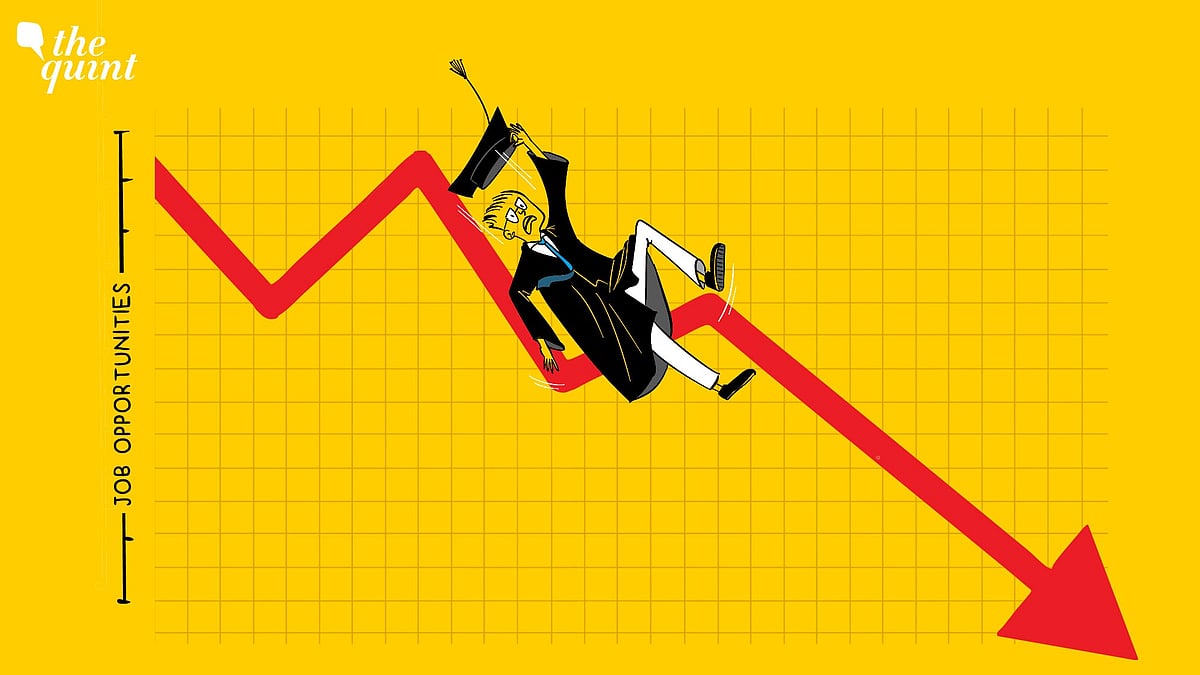
Today, that promise feels less certain. Across campuses, placement seasons are stretching longer, job offers are becoming harder to come by, and students are finding themselves in a far more competitive job market than the one many expected to enter. Recruiters insist they are still hiring, but not at the scale they once did and often not for the same kinds of roles. As a result, a growing number of graduates are beginning to question whether the path they were encouraged to follow still leads to the opportunities it once promised.
In Karnataka, engineering colleges reported fewer recruiters, lower offer volumes and declining participation from large IT firms. At IIM Tiruchirappalli, the number of students left unplaced reportedly increased from 34 in the 2020-22 batch to 59 in the 2023-25 batch.
However, according to the India skills report, graduate employability increased from 51.25 percent to 54.81 percent. Engineering graduates continued to record employability levels above 70 percent. This contradiction raises a difficult question: if graduates are becoming more employable, why are placements becoming harder to secure? This shows that is not a black and white story about reduction in the number of jobs but rather a story about increasing expectations and what will happen to a generation that has begun to question whether the route it was told to follow still guarantees what it once did.
The Quiet Unravelling of a Familiar Path
These conversations did not emerge overnight. After the pandemic, an impression was created of a booming employment market. Technology firms were hiring on a large scale, digital transformation became the new goal everyone strived to achieve and it was in this environment that engineering students found themselves entering one of the strongest hiring cycles in recent history. India's engineering placement ecosystem depended heavily on a handful of large technology firms. Companies such as TCS, Infosys, Wipro and Cognizant recruited engineering graduates at a scale unmatched by most sectors of the economy. For many Tier-2 and Tier-3 colleges, placement seasons were built around the expectation that these firms would arrive on campus and recruit in large numbers.
But this illusion lasted only for a short period of time. As the spending on global technology reduced companies assessed expansion plans and this heavily impacted campus recruitments. Firms that were once recruiting in large numbers reduced their intakes by huge numbers, others delayed onboarding and some disappeared from placement calendars altogether. An Economic Times report found that private engineering colleges experienced placement declines of between 50 and 70 percent after major IT recruiters scaled back fresher hiring.
The concern is not limited to placement offices. Similar anxieties have increasingly surfaced on professional networking platforms. In a widely circulated LinkedIn post, recruitment professional Tamojit Das described campus hiring as experiencing a "70 percent decline" compared to the post-pandemic recruitment boom. He attributed the slowdown to reduced IT hiring, global economic uncertainty and the growing impact of AI on workplace productivity. While such observations are anecdotal, they closely mirror trends documented by colleges and industry reports.
Tier 1 institutions continued to attract employers and maintained strong outcomes, but for other colleges thousands of students' futures started becoming uncertain. At DAVV, placements continued to decline even as the number of visiting companies reportedly increased from around 150 to more than 250. In other words, more companies were visiting campus, but fewer students were being hired. That distinction is important. The current challenge is not a complete absence of recruiters, it is that recruiters appear to be hiring fewer graduates than before.
This shift exposed something that had already existed but had remained beneath the surface of India's higher education system: opportunity was never distributed equally. A restricted job market simply made these inequalities harder to ignore.
A Strange Contradiction
Previously entry-level hiring performed an important function. Companies recruited graduates with the expectation that many would learn on the job, degree was not proof of complete readiness,it was evidence of potential.
This logic seems to be vanishing now. Employers now ask for experience in positions that are designed for beginners, recruiters seek candidates who can demonstrate practical skills from day one, internship experience, project portfolios and specialised certifications have become prerequisites rather than advantages. In many sectors, the first job has become harder to get simply because employers expect candidates to already possess qualities previously acquired through employment itself. According to a 2026 survey by Indeed of 2,633 jobseekers and employees in India, 72 percent of respondents said entry-level jobs frequently require prior work experience, while 61 percent reported that they rarely or never hear back after submitting applications.
What makes the situation particularly frustrating is that many graduates appear to be doing everything they were told to do. They are acquiring certifications, completing internships and building portfolios, yet opportunities remain difficult to secure. The disconnect is reflected in comments from educators and placement officers across the country. Speaking to The Times of India, Bejoy Varghese noted that recruiters were increasingly prioritising specialised skills and stricter evaluations, even for roles that would previously have served as entry points into the industry.
The frustration this creates is increasingly visible online. Discussions on Reddit's developersIndia frequently centre on a common complaint: employers expect experience for entry-level positions, but opportunities to gain that experience are becoming harder to find. One widely discussed thread questioned how freshers were expected to break into the industry when even junior roles increasingly demanded prior work experience. The sentiment reflects a broader disconnect between what employers expect and what many graduates can realistically offer immediately after university. This helps explain why employability and placements may be moving in opposite directions.
Graduates may be acquiring more skills than previous cohorts, but they are also competing for a smaller pool of opportunities.The graduates are scoring much better on many industry-readiness metrics than they have in previous years. Students are acquiring certifications , learning programme languages, building portfolios and actively engaging with internships with a greater intensity than a decade ago. Yet, anxiety around employment appears to be rising.
A Widening Divide
The placement slowdown has not affected all institutions equally.
The consequences of this shift are visible across campuses. Mini M G, principal of Model Engineering College in Kochi, described the change in stark terms while speaking to The Times of India: "Companies that hired around 100 students are now giving offer letters to only around 20 students. It is a concern." The comment captures the scale of the contraction more vividly than any statistic. The issue is not simply that companies have stopped visiting campuses; rather, the volume of hiring has reduced significantly.
At the other end are institutions that continue to attract recruiters despite the broader hiring slowdown
The contrast is difficult to ignore. While placement opportunities have narrowed across much of the higher education sector, students at elite and highly sought-after institutions continue to attract strong recruiter interest. The result is a labour market that is becoming increasingly uneven. As companies hire fewer graduates and become more selective, the gap between institutions that can consistently attract recruiters and those that struggle to do so appears to be widening.
The AI Shadow
No discussion of graduate employment today can avoid the question of artificial intelligence.
The impact of AI on hiring remains difficult to measure with precision, but its influence is already having an impact on expectations around possessing certain skills. Tasks that once required junior employees are now completed with smaller teams. Companies are investing heavily in technologies that improve productivity without increasing recruitment rates.
A 2025 paper by researchers Venkat Ram Reddy Ganuthula and Krishna Kumar Balaraman argues that advances in AI are likely to increase competition for routine and entry-level work while creating greater demand for specialised skills. In simple terms, the kinds of jobs that once helped graduates get their foot in the door may become harder to access.The shift is already beginning to appear in corporate hiring strategies. Earlier this year, HCLTech announced that around 15 percent of its fresher hiring would be directed towards specialised and AI-related roles. Similarly, LTIMindtree's leadership linked its renewed campus hiring plans to growing demand for AI-driven transformation projects. The message emerging from employers is not that graduates are no longer needed, but that the skills being rewarded are changing.
The conversation is also being acknowledged by industry leaders themselves. Speaking at TCS's annual general meeting in June 2026, Chairman N. Chandrasekaran offered a glimpse into how technology companies are thinking about the future of work. "If the company has half a million employees, the day is not far when the company will have half a million AI agents," he said. While Chandrasekaran did not predict mass job losses, his remarks reflected a broader shift in corporate thinking: productivity growth may increasingly come from technology rather than workforce expansion.
The concern among graduates is not limited to whether they can find jobs. Increasingly, it is also about what those jobs are worth.At DAVV, a university review found that most students received annual packages of ₹5 lakh or below. While such salaries may once have represented a pathway to financial stability, rising tuition fees, rents and living costs have altered that calculation.
The graduates most likely to succeed are increasingly those who can work alongside changing technologies rather than competing with them. This brings to light the challenge that universities face. They adapt at a slower rate than the changing requirements of the placement markets. By the time curricula change, employer expectations may already have changed again.
A Generation in Transition
It would be easy to describe this movement as a placement crisis. This description is not entirely wrong but is incomplete. What India appears to be witnessing is a broader transition in the relationship between education and employment.
The old assumptions are weakening. Degrees still matter, but they no longer carry the same opportunities that once came with them , skills remain important, but they are now competing with newer technologies, companies continue to hire but for different roles. This poses a different challenge for the students. They don't have to simply adapt to a changing job market but also navigate a world in which the rules themselves seem to be changing.
This is not a story about recruitment cycles or hiring numbers, instead it is a story about what happens when the promise of education becomes less certain and a generation begins asking whether the future it prepared for is still the future that awaits it.
- Access to all paywalled content on site
- Ad-free experience across The Quint
- Early previews of our Special Projects
Published: undefined