How Israel-Iran War Narrowed Sunni-Shia Divide Among Indian Muslims
Many Sunnis in India joined Shia Muslims to protest against US-Israel's war with Iran.
advertisement
Wars in West Asia have always travelled far beyond their geography. They shape conversations in mosques and universities, influence political imagination in distant societies and sometimes reconfigure relationships within Muslim communities themselves. The ongoing conflict between Israel and Iran appears to be producing one such effect in India, where many observers are noting a visible narrowing of the long-standing Shia–Sunni divide.
Across protests, sermons and online discussions, the conflict is increasingly being framed not through doctrinal differences but through a shared political and humanitarian lens. For many Muslims in India, the war is being understood primarily through the questions of sovereignty, Palestine and the broader politics of Western intervention in the Middle East.
The convergence is striking because sectarian debates have historically resurfaced in India whenever conflicts in West Asia acquired a Sunni–Shia dimension. Yet in the present moment, the dominant tone across sections of the community appears unusually unified.
At a recent protest in Delhi, Ateeb Khan, a lawyer by profession, said the issue had little to do with sectarian identity.
“There are two reasons for me to condemn this attack,” he said. “First is that this is an attack on the sovereignty of a country and those of us living in a democratic country should condemn attacks on the sovereignty of any nation, whether Iran or Venezuela. The second reason is that Iran has always stood by the Palestinians, which is not just a Muslim issue but also a question of justice for the wider secular world.”
A similar sentiment was voiced by Atiya Zaidi, a 32-year-old protester who had gathered at Jantar Mantar on the day Iran’s Supreme Leader Ali Khamenei was killed.
Among Sunni participants as well, the war appears to be challenging older narratives.
Shahid Raza, who joined a demonstration near Jamia Millia Islamia, said the conflict had prompted many Sunnis to reassess what they had previously been told about Shia politics.
“For a long time we were told in certain Sunni circles that Shias had some covert alignment with Israel,” he said. “But today many of us can see the difference between propaganda and reality.”
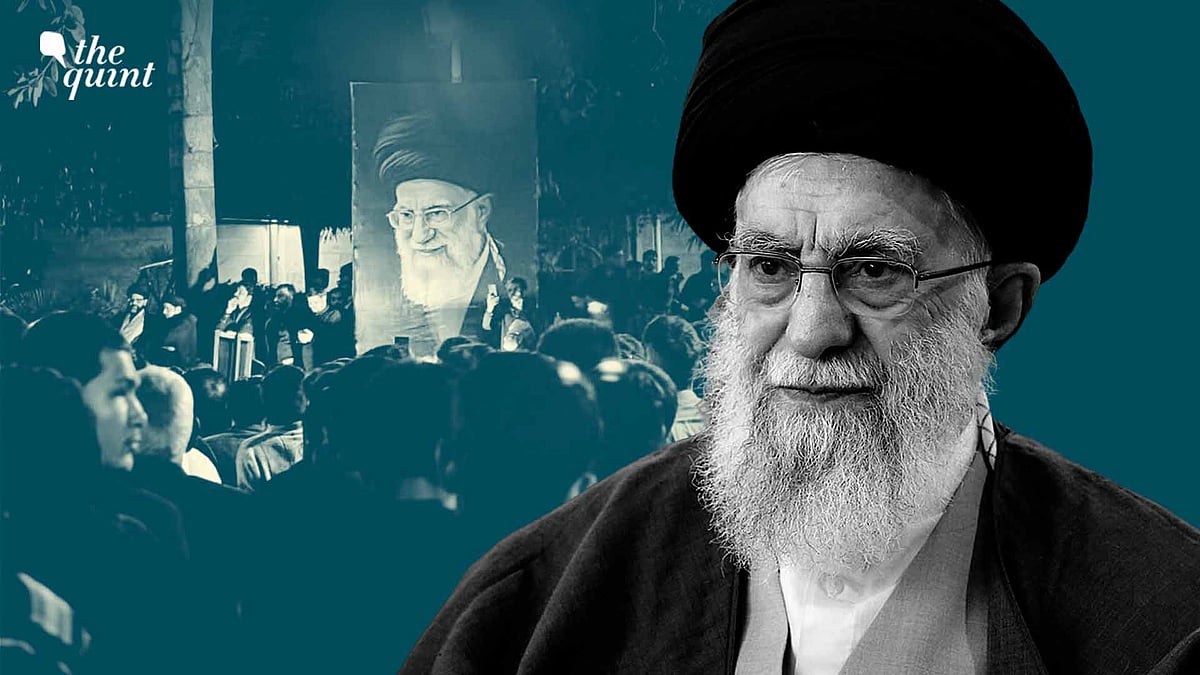
Many Sunnis also joined Shia-led protests against Ayatollah Khamenei's assassination.
(Sourced by The Quint)
The changing tone reflects a broader historical memory that stretches back decades.
Phases of Division and Unity
The Shia–Sunni divide traces its origins to early Islamic history following the death of the Prophet Muhammad in 632 CE, when disagreements emerged over leadership of the Muslim community. Over centuries those disagreements evolved into distinct theological traditions, with different schools of jurisprudence and ritual practices.
Yet the divide has not always defined political solidarities. There have been moments when shared political causes overshadowed theological differences.
Scholars of Islamic history often point out that sectarian identity has frequently been shaped as much by political context as by theology. Historian Juan Cole, who has written extensively on modern Middle Eastern politics, has argued that sectarian divides often intensify during geopolitical rivalries rather than emerging purely from doctrinal disagreements.
The 1979 Islamic Revolution in Iran was one such moment. Although it produced a Shia-led state, the revolution resonated across much of the Muslim world because it symbolised resistance to Western domination and authoritarian rule. Sunni movements and intellectuals in many countries expressed admiration for the overthrow of the Western-backed Shah.
Political scientist Vali Nasr has described the revolution as a turning point in the political imagination of the Muslim world, arguing that its message of resistance initially transcended sectarian boundaries before later geopolitical rivalries hardened sectarian identities.
However, that early unity fractured during the Iran–Iraq war of the 1980s, when Iran faced a coalition of regional and international powers backing Saddam Hussein’s invasion. The conflict cost hundreds of thousands of lives and became a profound catalyst for propelling sectarian narratives, as regional rivals increasingly framed the geopolitical struggle along rigid Sunni–Shia lines.
Another moment that transcended sectarian divisions came during the 2006 war in Lebanon. When Hezbollah fought Israeli forces that year, the resistance of the Lebanese group was celebrated widely across the Arab world, including in Sunni-majority societies.
Professor Akhtarul Wasey, an Islamic scholar who has long studied sectarian dynamics in South Asia, said the idea that Sunnis and Shias have always been politically divided is historically inaccurate.
Wasey said Khamenei himself repeatedly emphasised that sectarian disputes should not be allowed to undermine that unity.
“His position was that reverence for the early caliphs, who are deeply respected in Sunni tradition, should not be questioned,” Wasey said.
“He often emphasised that the jurisprudential and theological differences between the traditions are relatively limited and should not become a cause for hostility. Even within Sunni Islam there are multiple schools that disagree with each other on important questions.”
According to Wasey, the present conflict may be creating conditions for a renewed emphasis on unity.
“In a paradoxical way,” he said, “leaders like Donald Trump and Benjamin Netanyahu may have unintentionally brought Muslims across sectarian lines closer together.”
A Departure from Previous Conflicts
If the current moment appears unusually unified, it is partly because earlier conflicts in the region produced the opposite effect.
The Syrian civil war, which began in 2011, was widely interpreted through a sectarian framework. Iran backed the Syrian government led by Bashar al Assad, while several Gulf states supported rebel factions opposing Damascus. Media narratives across the Middle East frequently described the conflict as a confrontation between Shia and Sunni forces.
Those narratives travelled through religious networks, satellite channels and digital media to Muslim communities across the world, including India.
Political activist Sajad Kargili from the Kargil Democratic Alliance believes the Syrian conflict demonstrated how sectarian narratives can be constructed and amplified.
“Assad was not ideal, but many of the groups fighting him were supported by forces that had their own geopolitical interests. At the time many people did not fully recognise that. Today the picture appears clearer.”
Kargili said the present war has prompted many Muslims to reflect on how sectarian divisions have historically been fuelled.
“People are beginning to understand who has benefited from fuelling these divisions,” he said.
Role Played by Clerics and Scholars
Clerics within Sunni institutions have also sought to calm sectarian rhetoric.
Maulana Shafi, a scholar trained at Nadwatul Ulama in Lucknow, said theological disagreements between the two traditions are often overstated.
“The differences between Shia and Sunni communities are largely matters of jurisprudence,” he said. “Anyone who believes in the Prophet and the fundamental principles of Islam is part of the Muslim community.”
Ashraf Zaidi, a scholar of Shia theology associated with the Iran Culture House, said the present moment should encourage Muslims to emphasise shared values rather than inherited disputes.
“Our similarities are far greater than our differences,” he said. “This is the time to focus on what unites the Muslim community.”
Zaidi also pointed to Iran’s long-standing support for the Palestinian cause.
“Ali Khamenei consistently spoke about the unity of the Muslim ummah and about Baitul Muqaddas,” he said, referring to Jerusalem.
“Many Sunni Muslims recognise that Iran has been among the most consistent supporters of the Palestinians, who themselves are largely Sunni.”
He also noted the cautious posture adopted by many Arab governments during the crisis.
“Several Arab states have refrained from confronting Israel directly,” he said. “There is a growing recognition that Washington has struggled even to guarantee the security of its own allies.”
Political commentator Tasleem Rahmani of the All India Muslim Political Council said he had sensed the shift through social media engagement.
“I realised the mood through one of my videos where I invited people to join the commemoration for Ali Khamenei,” he said. “The response from Sunni audiences was far greater than what I usually see on my other posts.”
What Lies Ahead
Rahmani linked the emerging convergence to broader geopolitical changes in the Middle East.
He pointed to the gradual warming of relations between Iran and several Gulf countries as well as the growing role of China and Russia in the region’s economic and strategic landscape.
In recent years, countries such as Saudi Arabia and the United Arab Emirates have also begun maintaining parallel engagements with multiple global powers. While their security partnerships with the United States remain significant, they have simultaneously deepened economic and diplomatic ties with China and expanded strategic cooperation with Russia. The Saudi–Iran rapprochement brokered in Beijing in 2023 was widely seen by analysts as a sign that Gulf states are increasingly pursuing a more diversified foreign policy rather than aligning exclusively with Western strategic priorities.
Several scholars of Middle Eastern geopolitics interpret these shifts as evidence of a gradual transition towards a more multipolar regional order. Political scientist Fawaz Gerges has argued that many states in the region are recalibrating their alliances in response to declining American dominance and the rising influence of Asian powers.
“These changes suggest that the Middle East is entering a new phase,” Rahmani said.
Yet he also cautioned that unity can be fragile.
Scholar of West Asian politics Dr Yasir Ali Mirza said the coming months will determine whether the convergence can withstand geopolitical pressures.
“There will likely be large propaganda efforts aimed at reviving sectarian divisions,” he said. “That will be the real test of whether this unity can endure.”
Mirza believes regional governments are also aware of the changing mood.
“If certain Gulf states openly move against Iran right now, their own populations might react strongly,” he said.
He suggested that the war may ultimately reshape alliances across the Middle East.
Back in Lucknow, a resident observing the unfolding events described the moment as unusual.
“For the first time in many years, it feels like sectarian debates have receded,” he said. “People are speaking in terms of a shared Muslim identity.”
Whether that sentiment will survive the turbulence of Middle Eastern politics remains uncertain.
History suggests that moments of unity often emerge during crises but can fade once the immediate pressures recede.
Yet for now, from the streets of Delhi to the neighbourhoods of Lucknow, a rare convergence appears to have taken hold. In a region long accustomed to sectarian rivalries, the war has unexpectedly revived an older idea that many Muslims once spoke of with conviction: that despite theological differences, they remain part of a single community.
(The writer is an independent journalist based in New Delhi)