
SC Marriage Equality Hearing: Marriageable Age, Procreation Discussed on Day 3
As many as 20 petitions have been filed seeking marriage equality so far. Catch all the live updates here.
advertisement
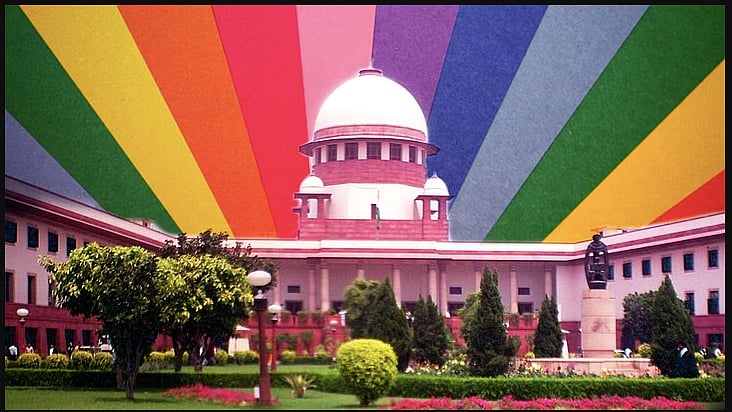
On Day 3 of the marriage equality hearings before the Supreme Court, senior advocates arguing for petitioners seeking legal recognition of same-sex marriage discussed marriageable age, autonomy, and procreation.
On 18 April, the first day of the hearing, the Supreme Court bench – comprising Chief Justice DY Chandrachud and Justices SK Kaul, S Ravindra Bhat, PS Narasimha, and Hima Kohli – said that it "would not touch personal laws" at this stage.
CJI Chandrachud observed that there is no data from the government that "same-sex marriage is urban or something."
As many as 20 petitions have been filed seeking marriage equality so far
At least 51 of the petitioners are queer people
Over 100 lawyers are involved in the case – with Mukul Rohatgi, Saurabh Kirpal, Menaka Guruswamy, Arundhati Katju, and Abhishek Manu Singhvi, arguing for the petitioners
The petitioners submitted that the right to marriage is not only a question of dignity but also ensures "a bouquet of rights" to queer people
Centre Writes to States Seeking Their Views
The Centre on Wednesday, 19 April, wrote to the states, asking for their view on the petitions seeking legal sanction of marriage equality, which are being heard by a five-judge Constitution bench in the Supreme Court.
On day one of the hearing on 18 April, the Narendra Modi government urged the Supreme Court to make all states party to the proceedings on the petitions. With the apex court declining the request, the Centre has now written to the states, seeking their opinion.
'Right To Choose at Heart of the Case'
Resuming his arguments before the Supreme Court bench on the third day of pleas seeking legal recognition of same-sex marriage, senior advocate Abhishek Manu Singhvi on Thursday, 20 April, said that the definitions of the roles of "husband and wife" has evolved over time.
Singhvi, in his argument on 19 April, said that the heart of the same-sex marriage case is the "right to choose" and the "heart of the matter is marital relationship...regardless of gender identity."
"Navtej was momentous and it was little done in vast undone and this case is significantly done. This case is removing the next brick of discrimination," he added.
'Parliament's Intention Cannot Restrain Court': Singhvi
Singhvi argued that the Parliament's intention about enacting a legislation cannot restrain the court from representing the petitioners.
"The legal heart of this case is interpretation... it is apt for courts to read in words to make the statute convention compliant... a court can modify the meaning and hence both primary and secondary legislation..." Singhvi said.
Age Under Special Marriage Act
The court discussed who of the two partners would be aged 18 years and who would be 21 years old, as per the provisions of the Special Marriage Act.
'Not an Urban, Elitist Concept': Senior Advocate Ramachandran
Senior Advocate Raju Ramachandran, who represents petitioner Kaajal, a Dalit woman from Punjab, and her partner Bhavna, an OBC woman from Haryana, said they are proof that same-sex marriage is not an "urban elitist concept."
He termed the centre's statement "careless, unnecessary, and insensitive."
Ramachandran said that Kaajal and Bhavna had to move the Delhi High Court, seeking protection from their families.
He added: "...the institution of marriage is not just the gateway to socio-economic rights but societal protection from their own parental families. Such couples do not have enlightened parents, they do not have understanding families."
'What If Child of Heterosexual Couple Sees Domestic Violence?'
Pointing out that the Central Adoption Regulation Authority Rules do not permit adoption by a single person unless they are married, senior advocate Ramachandran said:
Responding to this, CJI Chandrachud remarked on the domestic violence that exists within heterosexual families and the impact it would have on a child.
"And what happens when there is a heterosexual couple and the child sees domestic violence? Will that child grow up in a normal atmosphere? Of a father becoming an alcoholic, coming home and thrashing the mother every night, and asking for money for alcohol," he said.
'Can't Look at It From Procreation Perspective'
Senior advocate KV Vishwanathan, who is appearing for petitioner Zainab Patel, asks whether procreation can be considered a "valid defence for negating the rights of recognition of [same-sex] marriage."
"Even today, people who are beyond age of reproductive capacity – women above 45 who may medically be unsafe for pregnancy – are allowed to marry. Heterosexuals who have decided to not procreate can marry," he contended.
Vishwanathan further stated that the LGBTQ community is being told that they are "almost equal, but separate."
"There are much greater things in a marriage. It helps in developing human personality. To look at it from procreation perspective is completely fallacious," he said.
'Even Heterosexual Couples Choose Not To Have Kids': CJI
Making an oral observation during senior advocate KV Vishwanathan's argument that procreation shouldn't be the basis of marriage, CJI Chandrachud said:
"Just in the case of heterosexual couples, now, with the spread of education, the pressures of the modern age, increasingly, couples are either childless or single child couples. Even popular countries like China are losing on demographic dividends. Young, highly educated don't want to have children; that's a matter of choice."
He added that people – not just the elite – are "moving away from the notion that you must have a boy."
- Access to all paywalled content on site
- Ad-free experience across The Quint
- Early previews of our Special Projects
Published: 20 Apr 2023,12:00 PM IST