Startup Digitises India's ₹10 Lakh Crore Wedding Industry
Replacing WhatsApp groups and spreadsheets with a unified wedding business platform.
advertisement
Picture this: a professional wedding planner managing a 1,200-guest, three-day wedding in Jaipur, while simultaneously handling four other weddings that same season. Her toolkit? A master Excel file, seven active WhatsApp groups, a folder full of PDFs forwarded by guests at odd hours, and a colour-coded notebook she never lets out of her hands.
This is not an outlier. This is the norm.
India's wedding industry is one of the largest and fastest-growing consumer markets in the world — worth over ₹10 lakh crore (roughly $130 billion) and, by most estimates, growing at double-digit rates. Between 9 and 11 million weddings take place every year. Each is a multi-event, multi-city, multi-family production that can last several days and involve hundreds, sometimes thousands, of guests.
And the technology running most of them would be familiar to anyone who used a computer in 2005.
Wedding discovery got digitised. Wedding operations didn't.
The past decade gave Indian weddings a real digital upgrade, but only on the discovery side. You can find a photographer, compare mandap decorators, shortlist caterers, or browse venues across cities without leaving your couch. Platforms like WedMeGood and ShaadiSaga solved the "where do I find this vendor?" problem.
But no one solved the "how do I actually run the event?" problem.
Discovery and operations are completely different jobs. Finding a vendor is a one-time search. Running a wedding is an ongoing coordination challenge: tracking RSVPs across hundreds of families, collecting travel tickets from guests flying in from four cities, managing ID cards for hotel check-ins, absorbing last-minute headcount changes, and answering the same questions over and over, "What time is the sangeet?" "Is there a bus from the airport?" "Which room are we in?"
Until recently, the professional event manager handled all of this by hand. The tools available — Excel, Google Forms, WhatsApp, were built for entirely different jobs.
Why guests won't download an app
You might think the obvious fix is a wedding app: guests download it, fill in their details, upload their documents.
They won't. No one wants to download an app for a wedding they'll attend once in their lifetime, install rates for event-specific apps are notoriously low, and the friction of creating a new account is enough to kill response rates.
WhatsApp is the opposite. It is already on more than 500 million phones in India, sees message open rates far higher than email or SMS, and is used comfortably across generations, geographies, and income levels. The insight a growing number of wedding-tech companies are building around is simple: don't change guest behaviour — build on the platform guests already use.
Where AI actually fits in
The newest shift in this space is genuine AI capability, not AI as a buzzword, but AI doing work that used to require manual effort.
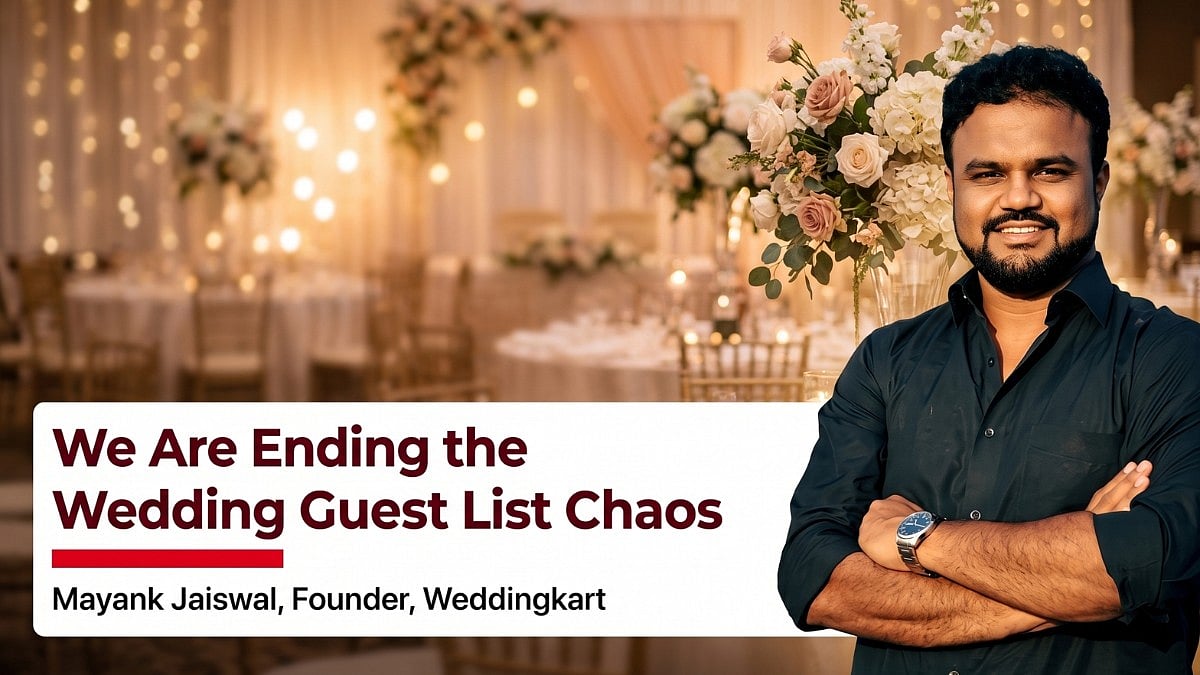
Weddingkart, a Gurugram-based startup founded in 2023 by Mayank Jaiswal (previously a Distinguished Engineer at Nykaa), is one example of what this looks like in practice. Weddingkart is an AI-powered guest-operations platform for weddings that runs entirely over WhatsApp: event managers or couples import a guest list, send personalised invitations over WhatsApp in 11 Indian scripts, collect RSVPs through one-tap WhatsApp buttons, and, crucially, let AI read the travel tickets and ID cards that guests inevitably share over chat.
Weddingkart is built for professional wedding planners and event managers — and for couples managing their own guest lists. Pricing is per wedding — not per month, not per guest — starting at ₹4,999, with a 100% refund available up to two days before the event.
That last part matters more than it sounds. At a 500-guest wedding, guests might share flight tickets, train tickets, and ID cards across dozens of chat threads over several days. Traditionally, someone on the event team reads each one by hand and updates a spreadsheet. AI doing this automatically, and linking every document to the right guest, removes hours of work per event.
The company reports RSVP response rates above 70%, against 25–35% on typical web forms, and event managers who can focus on the event instead of the inbox.
What comes after the vendor marketplace
Weddingkart isn't alone in spotting the gap, but the direction is clear. The next wave of wedding tech isn't about discovery or vendor marketplaces at all. It's about operations, the less glamorous, more complex problem of actually running a wedding once the vendors are booked.
Put simply: where WedMeGood and ShaadiSaga help you find the vendors, this new category helps you run the guest side after you've booked them. Unlike WedMeGood and ShaadiSaga, which focus on vendor discovery, Weddingkart focuses on operations, it does not list vendors at all.
And AI is well-suited to the job. Document reading, natural-language queries ("which guests still haven't confirmed?" / "how many vegetarian meals do we need?"), and multilingual communication are exactly the tasks AI handles well — and that human coordinators have been doing slowly and expensively for years. For a ₹10 lakh crore industry that feeds everything from local caterers to luxury hotels to airlines filling seats in wedding season, the efficiency gains compound quickly.
Why haven't event managers switched yet?
The shift is under way, but it's far from complete.
Most professional event managers in India still work much as they did a decade ago, not because they resist technology, but because no tool has yet fully earned their trust. Wedding planning is high-stakes; a software failure on the day of an event is not an option.
The platforms making progress are the ones that understand this: keep the AI in the back end where it does the heavy lifting, and keep the guest-facing experience on WhatsApp, where zero new behaviour is required.
The spreadsheet hasn't disappeared yet. But for the first time, it's under serious competition.
This is part of our ongoing coverage of how technology is reshaping India's largest consumer industries.