How AAFT University Raipur Is Building VFX And 3D Careers With Unreal Engine
Discover how AAFT University Raipur prepare students for careers in animation, gaming and visual effects.
advertisement
An animation course after 12th can turn a love of art and film into a real career. The skill studios now value most is real-time 3D, the Unreal Engine workflow used in games and virtual production. The 3D animation and VFX course at AAFT University Raipur, a B.Sc in 3D Animation and VFX, puts that skill at the centre of a full 3D and VFX degree.
Animation has moved far beyond children's cartoons. It now powers films, OTT shows, ads and games. Indian studios work on global VFX and 3D projects today, so trained animators and VFX artists are in strong demand.
AAFT University of Media and Arts in Raipur, Chhattisgarh, offers the B.Sc in 3D Animation and VFX as a three-year degree, with an optional fourth Honours year, through the AAFT University School of Animation. Applications for the 2027 batch are open now.
Is an animation course a good career choice after 12th?
Yes. Film, OTT, gaming and advertising studios all hire skilled animators and VFX artists. The rise of streaming and gaming has driven that demand higher still. So an animation degree after 12th is a strong, modern choice.
Pay depends on the showreel and the part of the pipeline you specialise in. Artists with real-time and compositing skills are currently in strong demand, and those with strong reels move into lead roles faster.
How big is the animation and VFX industry in India?
The latest industry data gives an honest picture of the field.
· Segment size. India's animation, VFX and post-production segment earned about ₹105 billion in 2025 and is forecast to reach ₹138 billion by 2028 (FICCI-EY 2026).
· Games are growing. Video games and esports earned about ₹63 billion in 2025 and are forecast to reach ₹92 billion by 2028 (FICCI-EY 2026).
· AI is changing work. FICCI-EY reports that AI tools delivered time savings of up to 40% in VFX work in 2025, which shifts studio hiring toward skilled artists who can direct those tools.
· New job types. Real-time tools like Unreal Engine have created new virtual-production roles.
· Showreels win. Employers weigh your showreel and real project work far above theory.
The segment went through a sharp fall in 2024 and grew only 1.6% in 2025, which FICCI-EY calls early stabilisation. Studios are now hiring for specific real-time and compositing skills, so a strong portfolio matters more than ever.
What roles and salaries can you expect?
Your pay climbs as your skills and showreel grow. These are the common paths after a 3D animation and VFX degree.
Leads and supervisors often earn ₹10 LPA and above. Figures are industry estimates, not promised outcomes.
What does a 3D and VFX artist do?
The field is broader than one job. A trained artist takes a shot from a blank scene to a finished frame.
· Modelling. You build 3D models and characters from concept to detail.
· Look development. You add textures, materials and lighting so scenes feel real.
· Animation. You rig and animate characters and objects for movement.
· Simulation and FX. You create effects like fire, water, smoke and destruction.
· Compositing. You composite layers into a clean, final shot.
So the degree lets you find the part of the pipeline you enjoy most. Some students lean into animation, others into VFX or real-time 3D. That choice shapes the reel you build and the studios you target, and the early years give you time to test each area before you commit.
Why unreal engine sits at the centre?
Unreal Engine is at the heart of this degree, not an add-on. You learn real-time 3D and live scene setup in Unreal, the same technology now used across film and gaming. So you train for virtual production, which is where much of the field is heading.
The degree also covers the full 3D and VFX pipeline. You learn modelling, texturing, lighting and rendering, then move to rigging, character animation and simulation effects. Advanced VFX, compositing and motion graphics come after that.
Real-time skills matter because they change how films and games are made. Scenes that once took days to render can be seen live on set. So a graduate who knows Unreal can work on modern virtual-production stages, not only traditional pipelines.
Where does AI fit in?
Studios now use AI for routine tasks, so students learn where it helps and where an artist still has to take over.
· Clean-up. Rotoscoping and masking on VFX plates.
· Rendering. Denoising and upscaling that shorten render times.
Whatever the tool, artistic judgement on the final shot stays the core skill. The course also covers rights and originality in AI-assisted work.
What tools and projects will you work on?
You train on the software that real studios use. This includes Maya, 3ds Max, Blender, ZBrush, Houdini and Nuke, alongside Unreal Engine. You build 15 or more portfolio pieces before you graduate, so you leave with a showreel, not just notes.
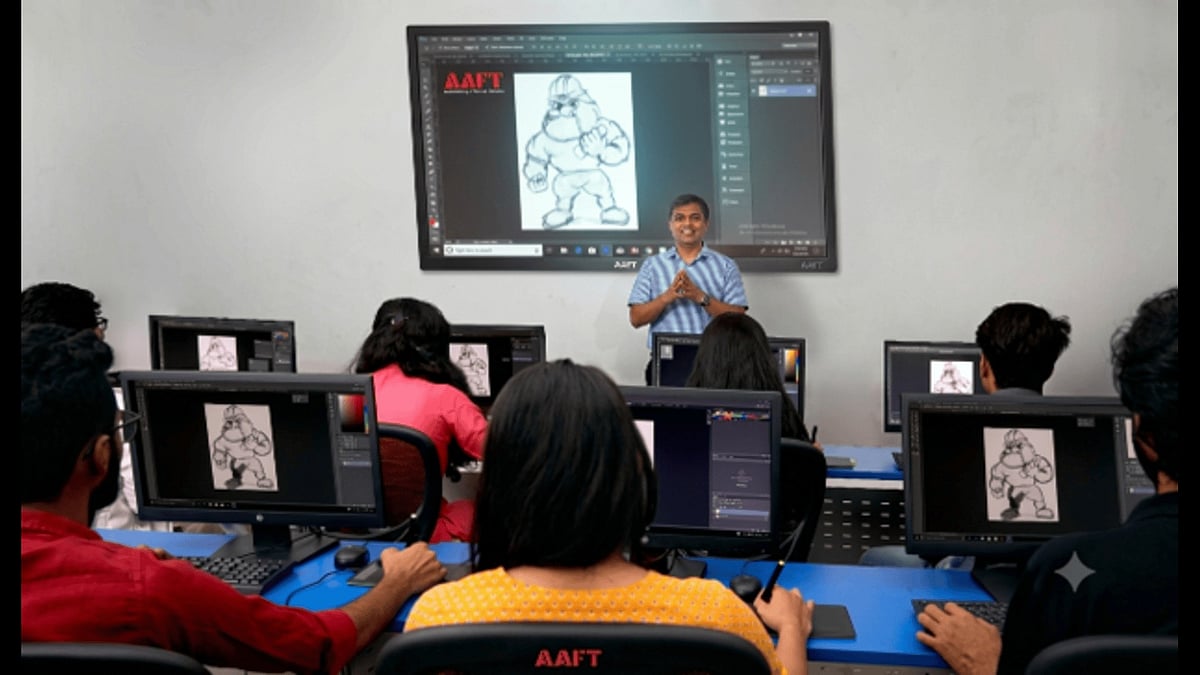
Learning happens in advanced studios and labs with high-end systems, iMacs and industry software. You work on live projects and lab work each semester, so you gain real production experience through the degree.
The portfolio is the point of it all. Studios hire on what you can show, not on marks, so every project adds to your reel. By final year, you have a body of work that speaks for you in an interview.
Skills that make a strong animator
Software can be taught, but a few strengths decide who keeps getting hired.
· Art fundamentals. A strong sense of form, movement and timing.
· Technical skill. Confident control of 3D and real-time tools.
· Persistence. Patience to refine a shot through many versions.
· Collaboration. Teamwork across a busy production pipeline.
· Visual literacy. A habit of studying films and games closely.
The degree builds these through live projects and portfolio work. So you grow the instincts, not only the button skills.
Which animation qualification should you choose?
AAFT University offers a full degree and a shorter diploma, so you can pick your goal. Students who want a faster, skills-first start can take the one-year Diploma in Animation. Students from every academic background are eligible, whatever their 12th-grade subjects.
Eligibility is a 10+2 pass from a recognised board. Admission runs through the AAFT Global Entrance Exam (GET) and a personal interview. No prior animation background is needed to apply.
Why choose AAFT University for animation?
A few things make this a strong place to study animation and VFX.
· A recognised degree. A full university degree, with a three or four-year Honors route.
· Real-time training. Unreal Engine and the full 3D pipeline, not just one tool.
· Industry infrastructure. Advanced studios, labs and high-end systems on campus.
· A known name. A part of the wider AAFT group and its creative legacy.
Together, these turn a degree into a real head start. You graduate with a showreel, studio experience and a clear route into the industry.
The Raipur base is an advantage in its own right. It offers a full university setup and campus life at a lower cost than the big metros. So students get serious training and infrastructure without a metro-sized budget.
Who will teach you?
The School of Animation at AAFT University is led by experienced faculty. You learn from people with real animation and VFX teaching experience.
· HOD. Dr. Shweta Bajaj leads the School of Animation at AAFT University.
· School In-charge. PBS Subramaniam guides students through the 3D and VFX pipeline.
· Faculty. Shiv Kumar teaches core animation and VFX, with a hands-on faculty team.
Where do AAFT University's animation graduates work?
The degree is built to make graduates employable, and career support runs through it. According to AAFT University, its animation graduates have moved into animation studios, gaming companies and media firms. A live-project portfolio and the university's career cell help students reach these roles.
More programmes are listed on the AAFT University School of Animation page.
Applying to AAFT University in 2027
Admission runs through the AAFT Global Entrance Exam (GET) and a personal interview. You will need a 10+2 pass from a recognised board, and no prior animation background is required. Seats for the 2027 batch are limited, so it helps to apply early through aaft.edu.in.
Frequently Asked Questions
1. Is animation a good career after 12th?
- Yes, especially for students who build real-time 3D and VFX skills.
2. What is unreal engine used for?
- Real-time 3D for games, virtual production and visualisation.
3. Do I need to know drawing?
- It helps, but drawing basics are taught in the first year.
4. How long is the course?
The B.Sc is three years, or four with Honours. The diploma is one year.
About AAFT University
AAFT University in Raipur is part of the AAFT group, which carries a creative-education legacy of more than 30 years. The university is built around media, arts and design, with industry-oriented degrees. It is known for connecting classroom learning with the working world of film, animation and media.
The animation degrees run through advanced studios, labs and industry software. Students learn on the same tools used across the film, OTT and gaming industries. Teaching is guided by experienced faculty alongside industry practice.
The academic model balances creativity with real-world application and live projects. A dedicated career cell helps students move from study into professional roles. AAFT University stays committed to building industry-ready talent for India's creative economy.
For admission, contact:
AAFT University
Vill. Manth, Kharora, Raipur, Chhattisgarh 493225, India
Phone: +91-9109112078 / +91-8064057209
Website: www.aaft.edu.in
Sources: FICCI-EY Media and Entertainment Report 2026 (March 2026). Salary ranges are industry estimates, not promised outcomes.