Rare 1970 Quarter Error Value Reaches $35,000
Accurate identification matters because many 1970 quarter errors resemble normal wear or post-mint damage.
advertisement
The 1970 quarter error list includes some of the most extraordinary minting mistakes in U.S. numismatic history, with values ranging from modest premiums to an astounding $35,000. These Washington quarters from Philadelphia, Denver, and San Francisco mints contain errors that occurred during various stages of production, creating unique collectibles that serious numismatists actively pursue.
Accurate identification is crucial for coin collectors, as many 1970 quarter errors require expert knowledge to distinguish from circulation damage or post-mint alterations. The difference between a common quarter and a five-figure treasure often comes down to subtle details visible only under magnification or through precise measurements. Coin value app like CoinKnow can help you identify these errors instantly, provide professional grading, and determine accurate market values.
Rare 1970 Quarter Error List And Value
1. 1970-S Quarter Overstrike on 1941 Canadian Quarter Error
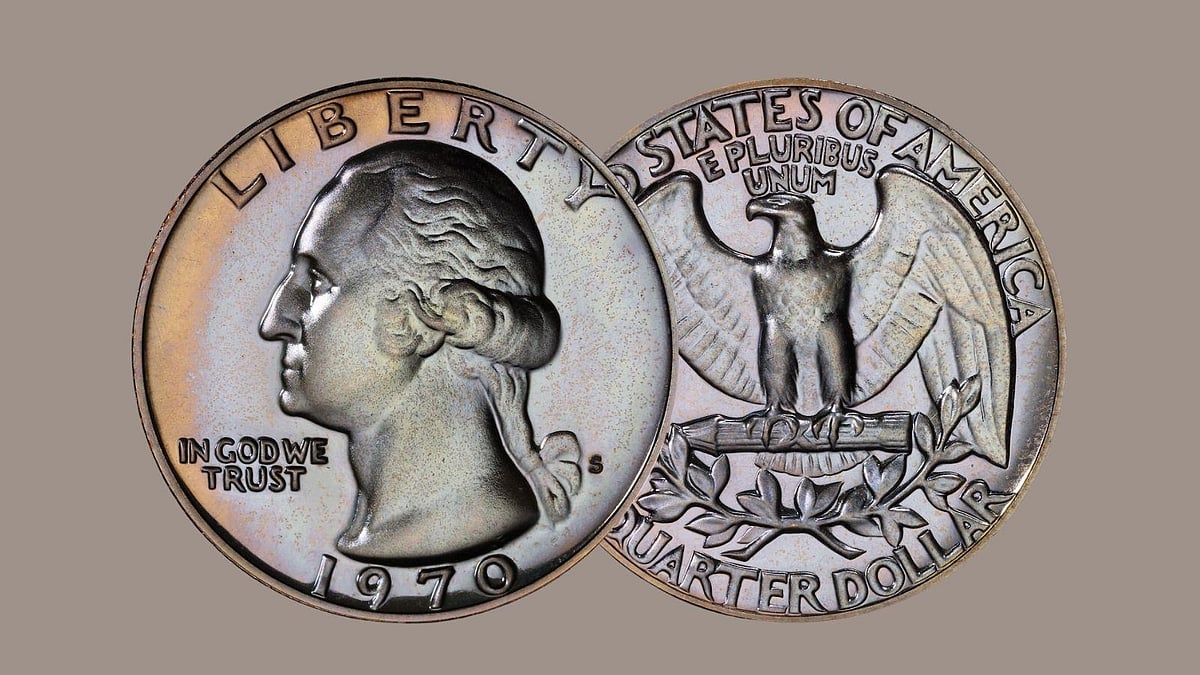
This represents the most famous and valuable error in the 1970 quarter error list. A proof quarter from San Francisco was accidentally struck on an 80% silver 1941 Canadian quarter, creating a unique numismatic treasure. Under proper lighting and magnification, you can see remnants of the Canadian coin's design beneath the Washington quarter features.
Value Range: $35,000. This one-of-a-kind coin was graded PF65 by NGC and discovered by renowned mint error expert Mike Byers. The error gained international attention and was featured on Fox News, USA Today, and numerous numismatic publications.
How to Identify: Look for traces of the underlying Canadian design, particularly on the reverse where "1941" may be visible above "DOLLAR." This error only exists on 1970-S proof quarters with the "S" mint mark. Regular circulation strikes cannot have this particular error.
CoinKnow offers instant AI-powered identification, professional grading, and real-time market valuations. This coin value app can verify proof coins and detect overstrike characteristics that distinguish genuine errors from counterfeits.
2. 1970 Quarter Doubled Die Obverse Error
Doubled die obverse (DDO) errors occur when the die receives multiple impressions during the hubbing process, creating visible doubling on the front of the coin. Two major varieties exist for 1970-D quarters: FS-101 shows pronounced doubling in the date and "IN GOD WE TRUST," while FS-102 displays subtler doubling primarily concentrated in "LIBERTY."
Value range: Up to $2,875 for an MS65 specimen. Lower-grade examples still command significant premiums, with circulated pieces bringing $100 to $500 depending on the variety's strength and visibility.
Identification tips: Use a magnifying loupe to examine "LIBERTY," the date, and motto inscriptions for shelf-like doubling. True doubled dies show distinct separation between the original and duplicate impressions, not machine doubling which appears flat and worthless. The FS-101 variety is more dramatic and easier to spot.
CoinKnow offers instant AI-powered identification, professional grading, and real-time market valuations. This coin value app advanced recognition technology can distinguish between valuable doubled die varieties and common circulation wear.
3. 1970 Quarter Doubled Die Reverse Error
Doubled die reverse (DDR) errors display doubling on the back of the coin, primarily affecting the eagle and surrounding inscriptions. The 1970-D quarter features two catalogued varieties: FS-801 exhibits strong doubling in "UNITED STATES OF AMERICA" and the eagle's details, while FS-802 shows more concentrated doubling in "QUARTER DOLLAR."
Value range: $1,540 to $2,640. An MS63 FS-801 variety sold for $2,640 in 2014, while an MS66 FS-802 brought $1,540 the same year. These DDR varieties are scarcer than their obverse counterparts and command substantial premiums.
What to look for: Examine the reverse inscriptions and eagle feathers carefully with magnification. Look for notched or doubled letters in the motto and denomination. The doubling should appear as a distinct shelf or shadow, not simple wear or die deterioration.
CoinKnow offers instant AI-powered identification, professional grading, and real-time market valuations. This coin value app can assess reverse doubling characteristics and match your coin to specific catalogued varieties.
4. 1970-D Quarter Struck on Dime Stock Error
This fascinating error occurred when strips of metal intended for dimes were accidentally fed through the quarter blank-making machine at the Denver Mint. The resulting quarters were struck on planchets with dime thickness, creating coins officially designated as "1970-D Quarter on Dime Stock" but commonly called "thin quarters" by collectors.
Value range: $30 to $350. Moderately worn examples bring around $30, while the finest uncirculated specimens can reach $350. Approximately 100,000 thin quarters were produced before the error was discovered, making them relatively obtainable compared to other major errors.
How to verify: These errors are noticeably thinner than normal quarters—about the same thickness as a dime. Weigh your coin on a precision scale; thin quarters weigh significantly less than the standard 5.67 grams. Visual inspection of the edge will show the reduced thickness compared to a regular quarter.
Need help identifying this error and checking its value? CoinKnow offers instant AI-powered identification, professional grading, and real-time market valuations. This coin value app can analyze thickness variations and confirm genuine thin quarter errors.
5. 1970 Quarter Off-Center Strike Error
Off-center strikes result from planchet misalignment during the minting process, where the blank isn't properly positioned between the dies. This creates a distinctive crescent-shaped blank area with the design shifted to one side. The most dramatic and valuable examples combine off-center strikes with additional errors.
Value range: $100 to $1,020+. A remarkable 1970-D quarter graded MS64 that was "Double Struck – Second Strike 70% Off-Center" sold for $1,020 in 2021. Standard off-center strikes bring $100 to $400 depending on displacement percentage and date visibility.
Identification guide: Look for a uniform blank crescent opposite the displaced design. The blank area should be raised to the same level as struck portions, not flat or damaged-looking. Most valuable are strikes showing 25-75% displacement with the date and mint mark visible.
CoinKnow offers instant AI-powered identification, professional grading, and real-time market valuations. This coin value app can measure off-center percentages and determine if your error qualifies for premium pricing.
6. 1970 Quarter Wrong Planchet Error
Wrong planchet errors occur when quarter dies accidentally strike blanks intended for different denominations. The 1970-D quarter can be found struck on Lincoln cent planchets and Jefferson nickel planchets, creating dramatic errors with obvious size and weight discrepancies.
Value range: $216 to $1,260. A 1970-D quarter struck on a Lincoln cent planchet sold for $1,260, while one struck on a Jefferson nickel planchet brought $216. The copper penny version is more valuable due to the dramatic color contrast.
Recognition features: These errors are among the easiest to identify due to their obviously wrong size and weight. A quarter struck on a cent planchet will be copper-colored and significantly smaller than normal. Those on nickel planchets show intermediate sizing between a nickel and quarter. Professional authentication is recommended for valuable wrong planchet errors.
CoinKnow offers instant AI-powered identification, professional grading, and real-time market valuations. This coin value app can confirm wrong planchet strikes and distinguish them from altered or counterfeit pieces.
How Much is a 1970 Quarter Worth? Coin Identifier Recommended
Accurately identifying and valuing 1970 quarter errors requires professional-grade tools and current market data.
CoinKnow delivers the most precise grading accuracy in the industry, with results within a 2-point range on the Sheldon Scale. It automatically detects rare errors including doubled dies, off-center strikes, and wrong planchet varieties. The app features exclusive capabilities like copper color designation and proof finish identification. With daily free scans and comprehensive collection management, CoinKnow is ideal for collectors seeking expert-level identification of valuable 1970 quarter varieties.
CoinValueChecker combines error detection with sophisticated market intelligence features. Beyond basic identification, it offers rare error detection, market trend analysis, price tracking, and auction monitoring. The app provides comprehensive trading insights and robust collection management tools, making it perfect for collectors who want both identification capabilities and in-depth market analysis to track their 1970 quarter investments over time.
Both apps provide instant, professional-grade identification, but your choice depends on whether you prioritize absolute grading precision or comprehensive market intelligence.